2025.07.29

CIEL Deputy Director Yang Attends Consultation on Draft Amendments to Third-Party Payment Contracts

On July 29, 2025, Professor Yueh-Ping Yang, Deputy Director of the Center for Innovative Enterprise Law (CIEL), was invited by the Administration for Digital Industries, Ministry of Digital Affairs, to attend the consultation meeting on the draft amendments to the “Mandatory and Prohibited Clauses for Standardized Contracts of Third-Party Payment Services.”

This draft amendment marks the first major review and revision of the regulation since its inception. Its aim is to adjust contractual content to better align with industry practices, reflect the development of emerging payment models, and further strengthen consumer protection. The revision focuses on addressing systemic gaps that have remained unamended for years, responding to the rapid evolution of industry and technology; updating contractual provisions to prevent consumers from facing information asymmetry or risks of compromised rights when using third-party payment services; and ensuring that contract terms adopted by providers comply with existing laws and enhance transparency.

During the meeting, Professor Yang offered his professional opinions on the draft provisions. In particular, he addressed issues such as the definition of third-party payment services, the circumstances under which providers may refuse to offer services or delay disbursement of funds, and the requirements for consumers to provide identity verification data. His observations and suggestions sought to balance regulatory frameworks with industry practice.

The Center for Innovative Enterprise Law will continue to closely monitor the evolution of digital payment and fintech contract regulations, while promoting the establishment of a regulatory environment that both fosters innovation and safeguards consumer rights.

2025.06.30

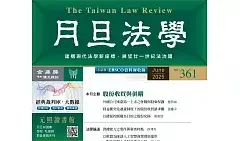
Professor Wang-Ruu Tseng Publishes Research on “Mergers & Acquisitions and Shareholder Protection in the Context of Foreign Companies’ Primary Listings in Taiwan” in the Monthly Review of Law (June 2025, Issue No. 361)

Professor Wang-Ruu Tseng, Director of the Center, published her study “Mergers & Acquisitions and Shareholder Protection in the Context of Foreign Companies’ Primary Listings in Taiwan” in the June 2025 issue (No. 361) of the Monthly Review of Law. The article provides an in-depth analysis and institutional reflection on the disputes over mergers and acquisitions (M&A) and shareholder protection that arise following foreign companies’ primary listings in Taiwan.

.

In the article, Professor Tseng notes that cases of delisting through M&A by foreign companies in Taiwan have sparked investor dissatisfaction and drawn close scrutiny from regulators. Under the current framework, shareholder protection mainly relies on provisions in companies’ articles of incorporation, but these provisions cannot contravene the mandatory laws of the companies’ home jurisdictions, thereby limiting their effectiveness. Furthermore, the Taiwan Stock Exchange adopts different regulatory approaches to M&A-driven delistings and other voluntary delistings, the rationality of which remains open to debate.

.

Specifically, when investors dispute the fairness of the M&A consideration in the case of Taiwanese companies, they may petition the court to determine a fair price. However, when the subject company is a foreign issuer, the interplay of governing law, international jurisdiction, and articles of incorporation often makes shareholder remedies more difficult. Using two Taiwanese cases with similar facts but divergent rulings as a starting point, and drawing on the experience of Cayman-incorporated companies facing shareholder litigation after going private and delisting in the United States, Professor Tseng analyzes the legal complexities and practical challenges involved. The study concludes that Taiwan should further clarify the applicable law and procedural design to better balance investor protection with the feasibility of cross-border regulation.

.

The full article is available for download at:
https://lawdata.com.tw/tw/detail.aspx?no=536137&listkey=

2025.06.12

Deputy Director Yueh-Ping Yang Invited to Present at Legislative Yuan Public Hearing on the Draft Virtual Asset Service Providers Act

On June 12, 2025, Deputy Director Professor Yueh-Ping Yang of CIEL was invited by the Finance Committee of the Legislative Yuan to attend the public hearing on the draft Virtual Asset Service Providers Act. Representing the research team commissioned by the Financial Supervisory Commission (FSC), Professor Yang shared key legislative considerations underlying the draft bill.

The hearing was convened by Legislator Lai Hui-Yuan, with representatives from the FSC, the Central Bank, and the Ministry of Justice in attendance. Several legislators, including Lin Szu-Ming, Huang Shan-Shan, Mai Yu-Chen, Chung Chia-Pin, Lai Shyh-Bao, and Ko Ju Chun, also delivered remarks.

In his presentation, Professor Yang emphasized that the draft Act is not a wholesale transplant of any single foreign model, but rather a comparative synthesis of frameworks from the EU, Japan, Hong Kong, and South Korea, adjusted for Taiwan’s market characteristics. The core principle is to classify virtual asset service providers (VASPs) as financial institutions subject to financial supervision, complemented by criminal liability provisions to address enforcement challenges where regulators currently lack inspection authority over unlicensed operators.

Regarding stablecoin regulation, Professor Yang noted that the draft bill applies only to fiat-backed stablecoins, while stablecoins pegged to other virtual assets or commodities are neither explicitly regulated nor prohibited. He also explained that, rather than attempting to regulate all emerging virtual asset businesses at once, the draft prioritizes higher-risk activities—such as lending services with established market presence—while granting regulators flexibility to expand oversight incrementally as needed.

Overall, Professor Yang highlighted that the draft Virtual Asset Service Providers Act serves as a “principles-based framework law”, providing a comprehensive supervisory structure while leaving room for subsidiary regulations and administrative orders to adapt dynamically to technological change, thus avoiding rigid rules ill-suited to the fast-evolving industry.

The full transcript of the public hearing is available here:
https://ppg.ly.gov.tw/ppg/SittingAttachment/download/2025060251/PPGB60500_2100_20988_1140618_0004.pdf

2025.06.10

Deputy Director Yueh-Ping Yang Invited as Panelist at the 2025 AI FinTech Development Forum on “AI Innovation, Internationalization, and Open Banking”

Deputy Director Professor Yueh-Ping Yang of CIEL was invited by the AI FinTech Association to serve as a panelist in the session “AI Innovation, Internationalization, and Open Banking” at the 2025 AI FinTech Development Forum, held on June 10, 2025.


The forum opened with remarks from Minister of Digital Affairs Yennun Huang, Vice Chairperson of the Financial Supervisory Commission (FSC) Yen-Liang Chen, and Deputy Minister of the National Development Council Jan, Fang-Guan. The keynote address was delivered by Shih Yi-Chun, Deputy Director-General of the FSC’s Department of Financial Innovation.


As a panelist, Professor Yang shared his views on how open banking and AI-driven financial innovation are reshaping supervisory models. He emphasized that modern financial supervision is shifting away from the traditional model of “government sets the rules, industry complies” toward a more market-oriented approach of “industry designs the rules, government reviews and approves.” This transition requires financial institutions not only to demonstrate compliance capabilities but also to develop rule-making capacity, grounded in an understanding of supervisory objectives and the risk management demands of technological innovation.


Professor Yang further introduced the concept of the emerging “Washington Effect” in contrast to the previously discussed “Brussels Effect,” stressing that market-driven supervisory approaches can facilitate cross-border FinTech development and enhance global competitiveness.


For related reporting on this forum and Professor Yang’s panel discussion, please refer to: https://techorange.com/2025/06/10/2025-ai-based-fintech/

2025.06.03

Visit from SMU Dedman School of Law to the Center for Innovative Enterprise Law

On June 3, 2025, the Center for Innovative Enterprise Law was honored to host a delegation from the SMU Dedman School of Law. Distinguished guests included Dean Jason Nance, Professor Chris Hanna, and Professor Martin Camp.

.

SMU Dedman School of Law is the alma mater of Mr. Hung-Tu Tsai, Chairman of Cathay Financial Holdings, who was also a key supporter in the establishment of the Center. This visit not only continues the longstanding friendship between National Taiwan University and SMU, but also lays the groundwork for deeper academic collaboration and international dialogue in the future.

.

The Center looks forward to continuing its academic exchanges with SMU Dedman School of Law, fostering international cooperation, and jointly expanding the vision and impact of enterprise law research.

2025.05.29

Deputy Director Yueh-Ping Yang Contributes Chapter “Trusts and Fund Structures in Taiwan: Laws and the Boundaries of Trusts” to Asia-Pacific Trusts Law, Volume 3: Boundaries in Context

Deputy Director Professor Yueh-Ping Yang of CIEL has contributed an English-language chapter entitled “Trusts and Fund Structures in Taiwan: Laws and the Boundaries of Trusts” to the newly published volume Asia-Pacific Trusts Law, Volume 3: Boundaries in Context, released by the international academic publisher Bloomsbury.


In this study, Professor Yang uses Taiwan’s investment fund regime as a case study to analyze the advantages and limitations of trusts as an “asset segregation mechanism” for investment funds. He highlights that the predominance of trust structures in Taiwan’s public funds is fundamentally linked to the institutional design of the Securities Investment Trust and Consulting Act (SITCA). By contrast, private funds in Taiwan tend to adopt corporate or limited partnership structures, a pattern also shaped by the relatively limited regulatory oversight under the SITCA.


Through his analysis of Taiwan’s differentiated regulatory design and practical operation of asset segregation mechanisms, Professor Yang demonstrates that the advantages of trusts are not absolute but instead depend heavily on the relative flexibility of a country’s trust law and business organization law, underscoring the strong contextual dependence on the legal system.


For more information about this publication, please refer to:
https://www.bloomsbury.com/uk/asiapacific-trusts-law-volume-3-9781509972951/


2025.05.27

Professor Yueh-Ping Yang, Deputy Director of the Center, Speaks at the “Soochow University Business and Finance Forum” on the Global Black Industry Chain of Fraud

On May 27, 2025, Professor Yueh-Ping Yang, Deputy Director of the Center, was invited to speak at the Soochow University Business and Finance Forum, joining representatives from government, industry, and academia to discuss the phenomenon and challenges of the global black industry ㄡchain of fraud.

.

The forum focused on the industrialization and organizational development of fraudulent schemes, and explored how to enhance society’s anti-fraud capacity from financial, technological, and legal perspectives. The event was chaired and introduced by former Premier Sean Chen, and featured distinguished speakers including Shu-Li Lin, Section Chief of the Crime Prevention Division of the Criminal Investigation Bureau, along with representatives from Business Today and JustDating.

Professor Yang participated as the academic representative, sharing his legal insights. He emphasized that the construction of anti-fraud legal frameworks must strike a careful balance between protecting citizens’ privacy and ensuring financial security. He also noted that different types of fraud require tailored regulatory strategies, with investment fraud being the most prevalent form in Taiwan. To address this, he suggested that Taiwan may need to strengthen its licensing regime for investment services and enhance regulatory oversight of fundraising and investment management activities in order to reduce the occurrence of investment fraud.

.

For related video information on this forum, please refer to:
https://www.youtube.com/playlist?list=PLKESzVds51wU7kbzwtB6EEZTYSR335DYq

2025.05.26

Deputy Director Yueh-Ping Yang Invited as Discussant for Professor Shinsaku Iwahara’s Lecture on “The Current Status and Challenges of Japanese Banking Regulation”

On May 26, 2025, the College of Law at National Taiwan University hosted a special lecture featuring Professor Shinsaku Iwahara, a leading authority on Japanese banking law, who spoke on “The Current Status and Challenges of Japanese Banking Regulation.”


Professor Iwahara’s lecture addressed a wide range of financial regulatory issues, including the separation of banking and commerce, foreign exchange business supervision, stablecoins, and central bank digital currencies (CBDCs). Deputy Director Professor Yueh-Ping Yang of CIEL was invited as the discussant, engaging in a cross-national dialogue with Professor Iwahara.


The two professors conducted an in-depth discussion on the similarities, differences, and distinctive features of regulatory frameworks in Japan, the United States, and Taiwan. Deputy Director Yang particularly raised questions regarding Taiwan’s ongoing regulatory developments in electronic payments, stablecoins, and digital currencies, inviting Professor Iwahara to share Japanese perspectives and experiences in these areas.


2025.05.22

Deputy Director Chao-Hung Chen Participates in Legislative Yuan Public Hearing on the “Financing Companies Act”

On May 22, 2025, the Legislative Yuan held a public hearing on the draft “Financing Companies Act,” bringing together scholars, experts, and regulatory agencies to discuss potential frameworks for the regulation of financing and leasing companies. Professor Chao-Hung Chen, Deputy Director of CIEL, was invited as a panelist to share his observations and recommendations.


Deputy Director Chen emphasized that before drafting a specialized law for financing companies, it is crucial to first clarify the underlying policy objectives. He noted that many social concerns—such as usury, fraud, and exploitative lending practices—are already addressed under existing laws, including the Civil Code, Criminal Code, Money Laundering Control Act, as well as the recently enacted “Four Anti-Fraud Laws.” He cautioned that if legislation targets only specific misconducts such as fraud, the result may be piecemeal and incomplete regulation. Worse, it could restrict the space for inclusive finance and drive those with genuine funding needs toward underground lenders.


Rather than hastily enacting a new specialized law, Deputy Director Chen suggested strengthening the use of existing legal and regulatory tools to enhance oversight of interest rates, disclosure requirements, borrower suitability, and fair trading practices. He recommended a gradual, evidence-based approach: observing market developments first, and only then determining whether a comprehensive and dedicated legal framework is truly necessary.


The complete record of the hearing is available at:
https://ppg.ly.gov.tw/ppg/SittingAttachment/download/2025051668/PPGB60500_2100_20988_1140603_0004.pdf

2025.05.12

⭐️ Event Highlights Recap (Part III): NTU CIEL Inauguration Ceremony|Corporate Law in the Era of Geopolitical Economy ⭐️

NTU CIEL Inauguration Ceremony|Corporate Law in the Era of Geopolitical Economy

May 12, 2025 – NTU College of Law, Tsai Lecture Hall, International Conference Hall


On May 12, 2025, the “Center for Innovation in Enterprise Law” (CIEL) was officially inaugurated at the International Conference Hall of the Tsai Lecture Hall, College of Law, National Taiwan University (NTU). The ceremony marked the unveiling of NTU’s first university-level legal research center and featured a thought-provoking roundtable forum on corporate legal innovation in an era shaped by geopolitical and economic shifts. Let us look back on the highlights of this landmark event.


The second roundtable session was moderated by Deputy Director Dr. Yueh-Ping Yang of the Center. He was joined by three distinguished experts from the public, private, and academic sectors:

Mr. Cheng-Chang Tung, Director General of the Banking Bureau at the Financial Supervisory Commission;

Mr. Kuo-Chu Ma, Chief Advisor at Chien Yeh Law Offices; and

Mr. Tzu-Yang Chen, Managing Director and Head of Investment Banking at Goldman Sachs Taiwan.


The session began with a keynote address by Director General Chen-Chang Tung of the Banking Bureau, Financial Supervisory Commission, who offered insights from the perspective of a financial regulator. Director Tung emphasized that in the face of global volatility and increasing challenges in financial supervision, Taiwan—being a densely populated island with limited natural resources—relies heavily on international trade as the backbone of its economy. Against this backdrop, Taiwanese banks have established nearly 650 overseas branches worldwide, ensuring that wherever Taiwanese businesses go, regulatory support follows. A robust legal framework, he stressed, is the foundation of stable banking operations.


He went on to explain that international regulatory standards must align with global norms. Taiwan is currently implementing Basel IV reforms to enhance the resilience of its banking sector and improve capital adequacy ratios. The government encourages banks to maintain sound capital structures and efficient capital turnover. Director Tung underscored the FSC’s commitment to supporting industries through all economic conditions, with a firm stance against “withdrawing the umbrella when it rains.” He reaffirmed continued support for SMEs, including the extension of existing loans.


Furthermore, Director Tung shared the FSC’s ongoing efforts to position Taiwan as a leading asset management hub in Asia. He noted that, driven by the strong performance of the shipping and semiconductor industries, total bank deposits in Taiwan have surged from NT$34 trillion in 2015 to NT$60 trillion in 2025. With many SMEs now entering second- or third-generation succession, the financial sector has a crucial role to play in facilitating stable wealth transfer. He concluded by highlighting the government’s dual strategy of retaining capital and attracting investment, aimed at strengthening Taiwan’s economy and upgrading its industries. The goal, he said, is to deliver visible results within two years, noticeable transformation in four, and substantial achievement in six.


Chief Advisor Kuo-Chu Ma of CHIEN YEH Law Firm drew on his extensive experience as a certified public accountant to share insights into the strategic planning of entrepreneurs, while offering a macro-level analysis of global economic trends and competitive dynamics. Approaching the topic from a political economy perspective, he explored the future of industrial chain integration, touching on key issues such as the tightening and loosening of monetary policythe resurgence of nationalist capitalismthe rebalancing of functional currenciesthe emergence of new economic barriers driven by ESG standardsthe evolution of responsible and sovereign tax regimes, and the reconstruction of taxing rights.


Mr. Ma emphasized that enterprises should proactively adjust the structure of their balance sheets and income statements, rather than shifting the burden entirely onto central banks or financial regulators. He urged Taiwanese companies to build transnational operational and legal alliances with strategic flexibility to stay competitive. Given that Taiwan’s economy is largely composed of family-owned businesses, where most business leaders are more accustomed to domestic legal frameworks, he stressed the importance of professional advisors providing forward-looking strategies and tailored solutions to help navigate the changing global landscape.


Mr. Tzu-Yang Chen, Managing Director and Head of Investment Banking at Goldman Sachs (Taiwan), shared practical insights based on industry observations. In the face of escalating geopolitical tensions and rising trade barriers, he emphasized that companies must adopt proactive strategies, such as strengthening their capital structures and pursuing mergers and acquisitions, to enhance both competitiveness and scale.


He noted that while Taiwan enjoys ample liquidity and an active secondary stock market, the primary market’s fundraising momentum remains relatively weak—an area he suggested should be a focus for future development. Additionally, consolidation within the financial sector is another effective avenue for improving structural resilience. He pointed out that the recent wave of overseas acquisitions by Taiwanese companies reflects a concrete response to shifting international dynamics.


Mr. Chen also highlighted the rapid growth of private equity funds in South Korea and Japan, which is reshaping corporate operations by enabling businesses to refocus, restart, and gain renewed market recognition—offering a potential path forward for Taiwanese enterprises.


However, he identified a key challenge in the regulatory approval process for mergers and acquisitions. Prolonged review periods may result in companies experiencing multiple market cycles during the waiting phase, amplifying uncertainty and risk. He called on the government to review and improve these regulatory procedures. In conclusion, Mr. Chen encouraged businesses to continue enhancing their competitiveness and expressed hope that financial regulators would provide meaningful support. He affirmed that the establishment of the NTU CIEL Center presents an excellent opportunity to engage in dialogue on these critical issues.


Deputy Director Yueh-Ping Yang concluded the session by reflecting on the insightful discussions. He emphasized that while the Center focuses on innovative and emerging topics—such as developments in technology—fundamental issues in corporate law, including corporate governance, mergers and acquisitions, and fundraising, remain timeless and continually relevant. Though shaped by different historical and geopolitical contexts, these core themes consistently deserve in-depth thought and rigorous academic exploration.


The event concluded with a closing ceremony, during which Deputy Directors Chao-Hung Chen and Yueh-Ping Yangof the Center delivered remarks.


Deputy Director Chen expressed his sincere gratitude to all the guests for their participation. He noted that the roundtable forum featured both an international perspective—with discussions on how the Trump era has influenced corporate legal systems—and insightful contributions from domestic experts representing academia, regulatory authorities, and the business sector. These included viewpoints on global academic researchTaiwan’s financial regulatory landscape, and cross-border mergers, acquisitions, and investments.


He expressed his hope that the Center will continue to invite scholars and professionals from home and abroad, bringing together diverse perspectives and fresh thinking to inspire new ideas and contribute to the continued development of Taiwan’s legal system.


Deputy Director Yang noted that the Center’s acronym, “CIEL,” means “sky” in French. He expressed the hope that the Center’s research will continue to reach new heights, making the NTU Corporate Legal Innovation Research Center not only a purely academic institution but also a collaborative platform for industry, government, and academia. Through ongoing exchanges, the Center aims to serve as a neutral hub, bringing together representatives from various fields to jointly foster the advancement of corporate legal systems.


With this, the inauguration ceremony and roundtable forum have successfully concluded. We sincerely thank all the distinguished guests for their insightful contributions and engaging discussions, and we are deeply grateful for the presence and support of all participants. The Center will continue striving to advance innovation in corporate legal systems, and we look forward to working hand in hand with more partners in the future to explore new possibilities together!

 
scroll_fix_img_mobile