2025.10.22

International Academic Exchange|Professor Catherine Malecki Visits CIEL to Discuss Sustainable Corporate Governance in Europe

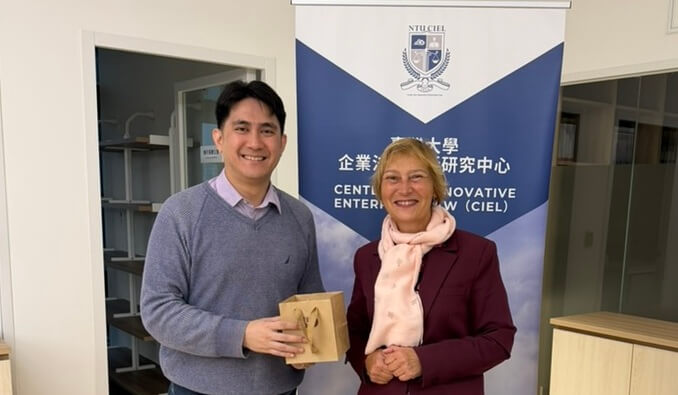
On October 22, 2025, CIEL was honored to welcome Professor Catherine Malecki from Rennes 2 University, France, for an academic exchange with Professor Yueh-Ping Yang , Deputy Director of CIEL, on recent developments in sustainable corporate governance and market regulation in Europe. Professor Malecki also delivered a guest lecture in Deputy Director Professor Chao-Hung Chen’s class on Financial Law.


Progress of Sustainable Governance in Europe
As the world has become more concerned of sustainability issues, the EU’s framework for sustainable finance and corporate governance has become more comprehensive in recent years. Nevertheless, a balance must still be struck between complexity and enforceability, in order to provide companies with predictable and enforceable standards to follow.


The French Experience
Among the EU’s recent sustainability-related initiatives, including the widely discussed Corporate Sustainability Due Diligence Directive (CSDDD), their legal prototype originated largely in France. France has established detailed domestic legislation and self-regulatory standards to implement the relatively abstract EU directives and regulations in this field. The influence of France’s sustainability rules on EU’s sustainability laws is, therefore, a subject deserving greater attention in comparative legal studies.


Taiwan’s Perspective
In recent years, Taiwan has advanced a series of corporate sustainability frameworks, including the Sustainability Taxonomy and ESGInfoHub, drawing largely from the EU model. Moreover, as Taiwan plays a key role in the global supply chain, the EU’s sustainability regulations exert a profound impact on Taiwanese enterprises. Given France’s role as a driving force behind EU’s sustainability laws, continued dialogue and exchange with France’s experience is of great value to Taiwan.


CIEL will continue to deepen interdisciplinary dialogue on sustainable corporate governance, compliance, and financial supervision, laying a solid legal foundation for corporate sustainability transitions.


2025.10.21

International Academic Exchange|Professor Nizan Geslevich Packin Visits CIEL to Discuss Global Financial Regulation

On October 21, 2025, CIEL was pleased to welcome Professor Nizan Geslevich Packin, jointly appointed at the City University of New York and University of Haifa, to the center for academic exchange. CIEL’s Deputy Director, Professor Yueh-Ping Yang, engaged in an in-depth discussion with Professor Packin on corporate governance and financial technology regulation, with a focused dialogue on three major topics: prediction markets, open banking, and crypto-assets.


Prediction Markets: Blurred Regulatory Boundaries

Professor Packin shared her recent research on prediction markets, highlighting how prediction markets and online gaming platforms seek to redefine themselves as financial services or futures market providers, thereby avoiding traditional gambling regulations. She further shared examples from the United States, including market operators acquiring shares in the Chicago Mercantile Exchange (CME) and interactions with the Commodity Futures Trading Commission (CFTC)—trends that may reshape the regulatory landscape in the future.


Open Banking: The Political Economy of Data-Sharing Governance
Deputy Director Yang shared his recent work on open banking, noting that his research draws on Professor Packin’s previous scholarship in the field. The dialogue extended to developments in the EU and Australia, and particularly the shifting stance of the U.S. Consumer Financial Protection Bureau (CFPB) regarding open banking—especially the political considerations behind data-sharing fees and access rights.


Crypto-Assets: The Balance Between Innovation and Oversight
Professor Packin shared her perspectives to be presented at FinTech Taipei 2025, and both scholars exchanged views on the regulatory rationales surrounding crypto-assets, including stablecoins. Professor Packin expressed regulatory concerns regarding the inherent risks of the crypto asset market and stablecoins, while Professor Yang shared his observation of Taiwan’s regulatory stances and evolving regulatory framework in this domain.


CIEL will continue to closely monitor the intersection of financial regulation and technological innovation and promote dialogues and collaborations between international scholars and global academic networks.


2025.10.18

CIEL Deputy Director Professor Yueh-Ping Yang Attends the Annual Meeting of the American Society of Comparative Law and its Younger Comparativists Committee

On October 16-18, 2025, CIEL Deputy Director Prof. Yueh-Ping Yang attended the annual meeting of the American Society of Comparative Law (ASCL) and its Younger Comparativist Committee (YCC), as YCC’s Co-Director, hosted in McGill University Faculty of Law, Canada. Prof. Yang further presented on “The Comparative Digital Asset Regulation and the Lesson for the United States.”


Prof. Yang began by quoting the statement of SEC’s Chair, Paul Atkins, that the U.S. is 10 year behind in digital asset regulation. He reviewed the rapid evolution of the digital asset market over the past decade and the regulatory issues related to ICOs, NFTs, stablecoins, the FTX collapse, Bitcoin ETFs, etc. Based on these reviews, he put forward a framework for classifying various digital asset regulatory issues and compared the different coverage in Japan, the EU, the UK, Singapore, and Hong Kong.


Based on the comparative analyses, Prof. Yang identified the development in various digital asset regulatory issues in the U.S. and analyzed the regulatory fragmentation by the SEC, CFTC, and other federal regulators. He proposed that the U.S. needs a comprehensive digital asset law to consolidate the needed regulations for offerors, market participants, and other business operators and clarify the respective role of each primary regulator.


Prof. Yang began to serve as ASCL YCC’s Co-Director in 2024 and will continue this position until 2026. CIEL will continue to support ASCL and YCC in that capacity, collaborating with comparativists in the U.S. and the world and encouraging studies by young comparativists.


2025.10.04

CIEL Deputy Director Yueh-Ping Yang Invited to Participate in International Forum | Global Legal Responses to Digital Assets

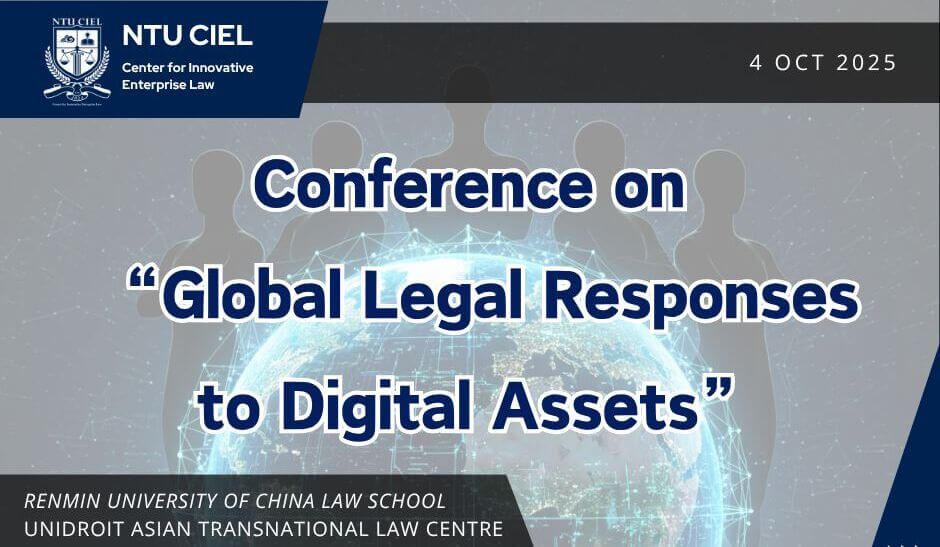
On October 4, 2025, CIEL Deputy Director Professor Yueh-Ping Yang was invited to participate in the “Global Legal Responses to Digital Assets” forum held in Beijing, jointly organized by the Renmin University of China Law School and the UNIDROIT Asian Transnational Law Centre (ATLC), and presented a speech at the Session on “Co-evolution of Digital Asset Private Law and Regulatory Law.”


The session featured international experts and scholars in digital asset laws, including Professor Teresa Rodriguez De Las Heras Ballell (President of European Law Institute) as the keynote speeker, Professor Tetsuo Morishita (former Vice President of Sophia University, Japan), Professor Pauline Pailler (Université Paris Cité), etc. They collectively explored the private laws and regulatory regimes for digital asset.


During the forum, Professor Yang shared his insights on the regulation of crypto-asset lending activities. He commenced the speech by the recent controversies surrounding stablecoin lending activities, analyzing the business model, inherent risk, and comparative regilation regarding crypto-asset lending businesses and comparing them with shadow banks. Deputy Director Yang also highlighted serveral potential regulatory tools, such as consumer protection and disclosure, internal control and financial management, prudential regulation and financial requirement, liquidation designs, and entity shielding requirements, in order to respond to the constantly evolving crypto-financial ecosystem.


2025.09.30

CIEL Deputy Director Professor Chao-Hung Chen Publishes New Research

How corporations disclose their carbon emissions information has become a crucial issue for corporate governance and in the capital market in recent years. In September 2025, CIEL Deputy Director and Associate Professor Chao-Hung Chen published an article titled “Carbon Emission Disclosure and Greenwashing Risk in the Capital Market” in the NTU Law Journal.

Professor Chen’s study examines the disclosure practices of publicly listed companies in Taiwan regarding their GHG emissions between 2011 and 2021. While the article agrees that disclosure is an important tool to promote carbon reduction, the study suggest that the effectiveness of carbon disclosure must depend on whether the information disclosed is accurate, comprehensive, and comparable to offer useful data to the market.


Highlights:

  1. Limited effectiveness voluntary disclosure — Few companies disclosed their carbon emission data voluntarily before mandatory rules took effect, supporting the move toward a mandatory disclosure regime.
  2. Fragmented and inconsistent content — Disclosure statements were often brief and inconsistent in format and content. Much information lacked third-party verification, showing signs of selective or incomplete reporting.
  3. Significant greenwashing risk — Many firms relied on vague qualitative descriptions rather than concrete quantitative data, making it difficult for investors and regulators to assess real carbon reduction outcome.


Professor Chen emphasizes that regulators should strike a balance between lowering disclosure costs and enhancing the substance of disclosure as well as to establish quantifiable data over time in order to strengthen the credibility and market value of ESG information.

Abstract:https://lnkd.in/g-cChVSE

2025.09.11

Deputy Director Yueh-Ping Yang was invited as a Speaker at the“IADI Core Principles International Conference”

In September 11, 2025, at the “IADI Core Principles International Conference” held in Taiwan by the International Association of Deposit Insurers (IADI).CIEL Deputy Director Professor Yueh-Ping Yang was invited to serve as a panelist, sharing on the topic of “The Impact of Digital Financial Innovation on the Deposit Insurance System.”


This session focused on whether emerging financial instruments such as electronic payments, stablecoins, and deposit tokens should be covered by deposit insurance. From an academic perspective, Deputy Director Yang proposed three key criteria for the assessment: liquidity risk, contagion risk, and the money creation function, which sparked enthusiastic responses and in-depth discussions among representatives from various countries.


IADI is an international standard-setting body for deposit insurance systems, and Taiwan’s Central Deposit Insurance Corporation is IADI’s formal member. This year’s conference, held in Taiwan, comes at a significant moment for the revision of IADI’s Core Principles since 2014, and coincides with the 40th anniversary of the Central Deposit Insurance Corporation, giving it profound significance.

2025.08.21

Deputy Director Yueh-Ping Yang Invited to the “2025 Cathay Financial Holdings Digital Asset Trends Forum” as Moderator and Panelist

On August 21, 2025, CIEL Deputy Director Professor  Yueh-Ping Yang was invited by Cathay Financial Holdings to attend the “2025 Cathay Financial Holdings Digital Asset Trends Forum,” where he served as both a moderator and a panelist. Drawing on perspectives from law and financial regulation, Professor Yang provided an in-depth analysis of the institutional challenges and policy issues arising from the development of digital assets.


This forum marked the first large-scale public forum on digital asset–related topics organized by a domestic financial institution in Taiwan. Director Brenda Hu and Deputy Director Yi-Chun Shih of the Financial Supervisory Commission’s Department of Development and Innovation were also invited to deliver keynote speeches and participate in panel discussions. Following the forum, Cathay Financial Holdings released the “Digital Asset Trends Insights” report, to which Professor Yang contributed a column sharing his research perspectives and policy recommendations.


Professor Yang’s participation in the forum focused on two key sessions:
1. As a panelist in the session “Innovation in Virtual Asset Custody Services and Anti-Money Laundering,” Professor Yang offered a comparative analysis of domestic and international legal frameworks, highlighting the strategic importance of virtual asset custody services in financial institutions’ expansion into related businesses. He further examined the respective institutional roles and comparative advantages of financial institutions and virtual asset service providers (VASPs) in the area of custody services.
2. As the moderator of the session “Regulatory Considerations and Future Challenges for Financial Institutions Operating VASP Businesses,” Professor Yang facilitated dialogue among perspectives on digital financial business development, regulatory compliance practices, and external financial supervision. The discussion explored priority areas for financial institutions in developing virtual asset businesses, the corresponding internal control and risk management mechanisms required, and expectations regarding financial laws and regulatory frameworks.


The forum focused on key topics including real-world asset tokenization (RWA), stablecoins, and virtual asset custody, and brought together financial institutions, domestic and international industry representatives, and regulatory authorities to engage in substantive discussions on future trends and institutional design in the digital asset market. Professor Yang’s participation underscores CIEL’s long-standing commitment to research in digital financial law and its continued role in bridging academia, public policy, and industry practice.


Forum video website: https://reurl.cc/8bZ7Yy
Digital Asset Trends Insights report: https://reurl.cc/W8ZWb9

2025.08.01

Professor Chao-Hung Chen Awarded NSTC Grant for Three-Year Research on Tokenization and Legal Infrastructure

Professor Chao-Hung Chen, Deputy Director of the Center for Innovative Enterprise Law (CIEL) at National Taiwan University, has recently been awarded a three-year research grant by the National Science and Technology Council (NSTC), recognizing his academic contributions and research potential in the fields of fintech and digital asset regulation.

.

The approved research project, titled “A Study on the Tokenization of Financial Markets and Its Legal Infrastructure”, will run from 2025 to 2028. The study will focus on the transformative potential of tokenization in reshaping the structure of existing capital markets and explore the legal infrastructure required to support such transformation. The project not only continues the Center’s commitment to the development of digital financial regulation but also builds on the key themes highlighted in CIEL’s 2024 salon.

.

As fintech and digital assets increasingly converge, designing a legal framework that balances innovation with risk management has become a critical issue for global research and policy agendas. Through this project, CIEL aims to further strengthen its position at the forefront of digital financial law research and to provide concrete policy recommendations for Taiwan’s future regulatory design. The Center also intends to share the project’s findings and progress on public platforms, fostering dialogue between academia and practice.

2025.07.31

CIEL Director Professor Wang-Ruu Tseng and Deputy Director Professor Yueh-Ping Yang Invited to Attend FSC Public Hearing

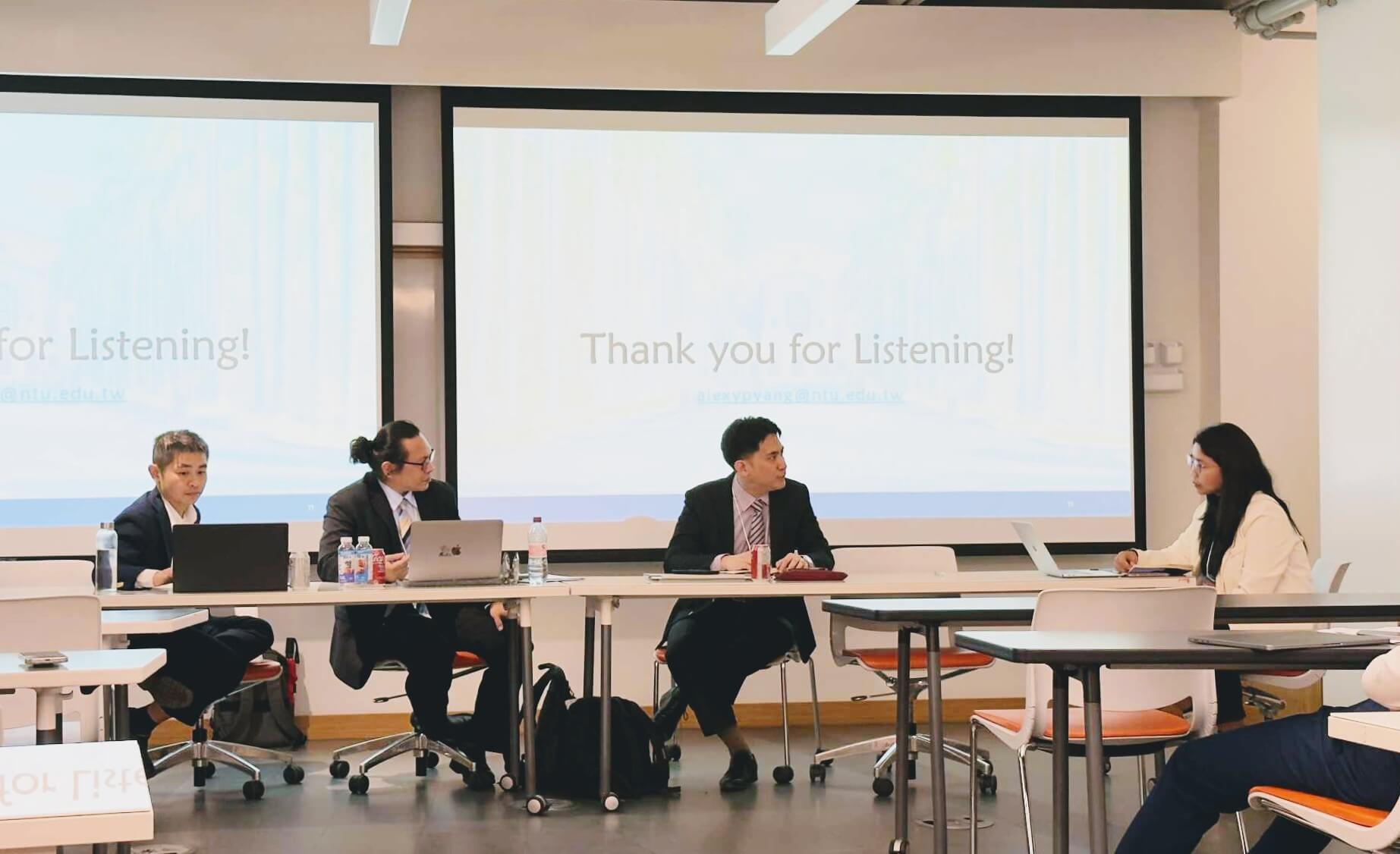
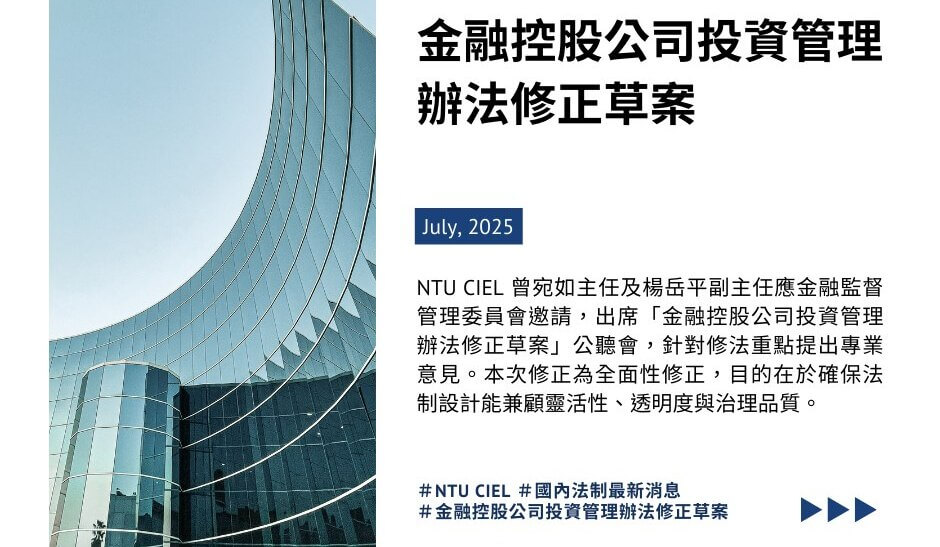
On July 31, 2025, Professor Wang-Ruu Tseng, Director of the Center for Innovative Legal and Economic Institutions (CIEL) at National Taiwan University, and Professor Yueh-Ping Yang, Deputy Director of CIEL, were invited by the Financial Supervisory Commission (FSC) to attend a public hearing on the draft amendments to the Regulations Governing the Investing Activities of a Financial Holding Company. At the hearing, they offered expert insights on key aspects of the proposed revisions, drawing on both academic research and practical experience.


The proposed amendments were initiated by the FSC in response to recent trends in financial sector consolidation and were formulated with reference to both domestic and international merger and acquisition practices. The primary objective of the revisions is to better align the regulatory framework with market realities while strengthening market order and corporate governance. During the hearing, scholars and industry representatives engaged in in-depth discussions on several critical issues, including adjustments to the shareholding thresholds for initial investments, the requirements for non-consensual mergers and the submission of feasibility plans, restrictions on consideration methods in tender offers, disclosure requirements, and the roles of boards of directors and audit committees in investment decision-making processes.


The FSC further explained that the amendments seek to reaffirm the statutory concept of controlling shareholdings under the Financial Holding Company Act while reducing regulatory uncertainty in merger and acquisition transactions. Key measures include clarifying documentation requirements for initial investments, allowing adjustment periods for the dual leverage ratio (DLR), and incorporating opinions from independent experts and audit committees to enhance the quality and procedural integrity of board decisions. In addition, the amendments regulate the timing of tender offer disclosures to prevent unnecessary market volatility prior to regulatory approval, thereby safeguarding market stability and shareholder interests.


Several recommendations raised during the public hearing by academic and industry participants were subsequently incorporated into the final amendments officially announced by the FSC on November 25, 2025. This reflects the FSC’s commitment to an inclusive consultation process and its efforts to strike an appropriate balance between regulatory oversight, market flexibility, and sound corporate governance.


CIEL has long been dedicated to the study of financial regulation and corporate governance. Going forward, the Center will continue to engage in public policy discussions and contribute academic and practical perspectives to support the development of a more transparent, resilient, and forward-looking legal framework for financial mergers and investment management.


the officially promulgated amendments

Regulations Governing the Investing Activities of a Financial Holding Company

2025.07.30

CIEL Deputy Director Yang Chairs 56th Symposium on Economic Crime Prevention

On July 30, 2025, Professor Yueh-Ping Yang, Deputy Director of the Center for Innovative Enterprise Law (CIEL), was invited by the Investigation Bureau of the Ministry of Justice to chair the “56th Symposium on the Prevention of Economic Crime: Emerging Criminal Issues and Countermeasures in Third-Party Payment Services.”

.

The symposium focused on criminal techniques used to conceal illicit financial flows through third-party payment channels, as well as the new anti-money laundering (AML) challenges faced by third-party payment providers following the amendment of Article 6 of the Money Laundering Control Act and the implementation of the Regulations Governing Anti-Money Laundering and Service Capacity Registration for Third-Party Payment Service Providers on November 30, 2024.

.

The event opened with remarks by Deputy Director-General Wu Yi-kung of the Investigation Bureau and featured distinguished panelists, including Judge Hsing-I Lin of the Taipei District Court, Chief Prosecutor Tzu-Wei Cheng of the Qiaotou District Prosecutors Office, Inspector Ling-Ping Su of the Administration for Digital Industries, and Eric Liu, General Manager of Green World FinTech. Together, they discussed preventive measures against crimes involving third-party payment services from four perspectives: judicial practice, prosecutorial investigation, regulatory policy, and industry self-regulation.

.

In his role as chair, Professor Yang highlighted that since 2021, Taiwan has established clearer AML regulations for third-party payment providers, with the Administration for Digital Industries serving as the administrative regulator. Following the 2024 amendments, regulatory controls have been further strengthened. To effectively prevent third-party payment services from becoming conduits for illicit financial flows, closer coordination between administrative regulators and law enforcement authorities will be essential. The symposium also extended discussion from the “Kyushu Case,” examining the role of third-party payment systems in facilitating illicit fund transfers and addressing new criminal patterns such as “fake three-way transactions,” underscoring the importance of inter-agency cooperation and public-private collaboration.

.

The Center for Innovative Enterprise Law will continue to monitor AML developments and the maintenance of financial order in the digital economy, while promoting a more rigorous, transparent, and adaptive legal framework to meet the challenges posed by emerging financial crimes.

可能是 10 個人和文字的圖像

 
scroll_fix_img_mobile