2025.11.21

Events

2025 Corporate Legal Innovation Symposium|Round-Table Forum

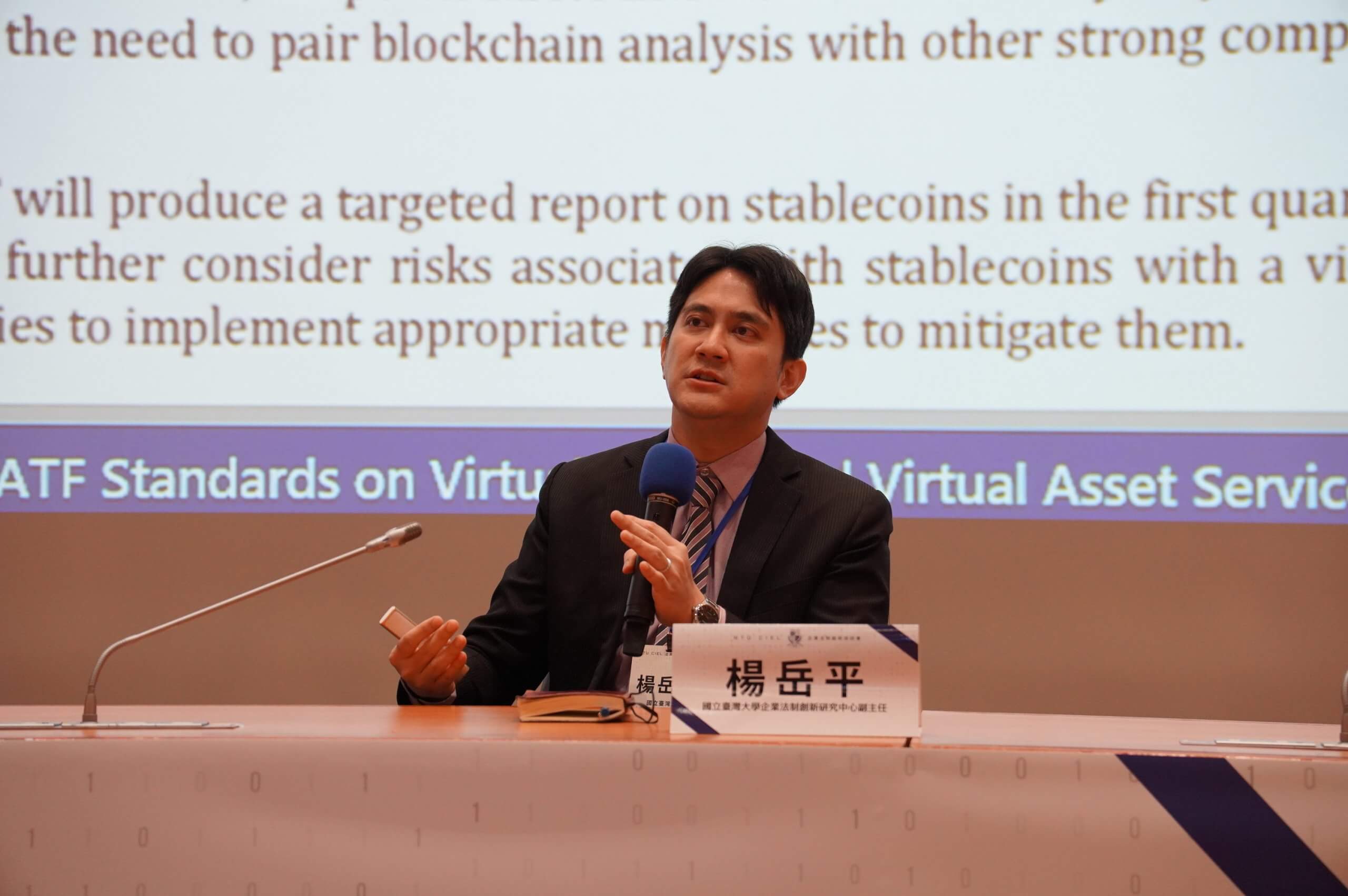
The roundtable session was moderated by CIEL CEO Chung-Chia Huang, joined by panelists Deputy Director Chao-Hung Chen, Deputy Director Yueh-Ping Yang, Prof. Ying-Shin Tsai, and Assoc. Prof. Yi-Chen Lai.


Legal Characterization of Tokenization

CEO Chung-Chia Huang opened the discussion by raising a core question: Should the legal nature of tokens be determined by the underlying rights they represent or by the electronic records on the blockchain itself? Deputy Director Chen opined that tokens often sit between claims and property rights, functioning more like “value carriers.” He noted that the current international trend increasingly relies on the concept of “control” to determine ownership. This elevates the role of system operators in identifying and transferring rights. Deputy Director Yang observed that domestic courts tend to treat tokens as movables, while academics consider them intangible assets; the legal categorization remains unsettled. Associate Prof. Lai further reminded the audience that whether tokens possess exclusive control is still unclear—reflecting the ongoing evolution of their legal nature.


Regulatory Adjustments and Tokenized Payment Instruments

On the regulatory front, panelists emphasized the need to consider emerging risks within the existing legal and regulatory framework. Deputy Director Yang explained that if a tokenized payment instrument retains its original functional characteristics, existing regulations may continue to apply. However, when market volatility, ledger unpredictability, or anonymity introduce new risks, regulatory reinforcement becomes necessary. Many jurisdictions regulate stablecoins under frameworks similar to electronic payments, illustrating this approach. He also noted that tokenized payments exert limited impact on monetary policy, as funds ultimately settle back within the banking system.


Cross-Border Finality and AML Challenges

During the open Q&A, participants first asked how to determine finality in cross-border transactions. Deputy Director Yang explained that if a single stablecoin dominates the market, its issuer can define finality within its system. However, in a more diverse market, financial institutions probably can negotiate common principles to define finality through contracts. Globally, two approaches coexist: one relying on the distributed ledger itself as the basis for finality, and another centered on “control,” which is conceptually closer to possession.

Regarding AML, when smart contracts automatically settle transactions to blacklisted addresses, risk allocation often depends on contractual arrangements. However, if blacklist information relies on international databases, information asymmetry may arise—posing an important regulatory challenge for Taiwan.


Global Trends in Tokenization

Finally, audience asked about international use cases and trends for tokenizing financial and non-financial assets. Deputy Director Chen noted that global regulation remains fragmented, with high-value financial assets more likely to be tokenized first. Assoc. Prof. Lai highlighted Japan’s experimentation with lower-value assets—such as alcohol products, GameFi items, and hotel usage rights—to reduce public concerns, suggesting that tokenization may expand gradually from everyday-use scenarios.


CIEL will continue advancing research on RWA, tokenized payment instruments, and Web 3.0 financial regulation. Through interdisciplinary analysis across civil law, criminal law, financial regulation, and international standards, we aim to offer concrete policy recommendations. Our goal is to help Taiwan build a corporate legal framework that balances innovation with stability amid rapid technological and regulatory transformation, while strengthening CIEL’s role as a key platform for industry–government–academia dialogue and legal innovation.


2025.11.21

Events

2025 Innovative Enterprise Law Seminar|Session Ⅱ Recap

The second session of the seminar was led by Professor Yueh-Ping Yang , Deputy Director of CIEL, with Professor Ying-Hsin Tsai as discussant. The session focuses on “Tokenization of Payment Instruments”. The seminar provided an in-depth analysis of the institutional framework, risks and future regulatory directions of payment tokenization from comparative perspectives.


Operation Models and Risks of Stablecoins
Professor Yang noted that stablecoins share many characteristics with tokenized forms of e-money. Using the distinction between primary and secondary markets, he explained the legal structure of stablecoins: while subscription and redemption in stablecoin’s primary market resemble e-money, stablecoin’s secondary-market circulation is beyond the offeror’s control and more depends on virtual asset service providers. As a result, stablecoin faces new risks in addition to that of e-money in areas such as AML compliance, ledger governance, and price de-pegging.


Global Regulatory Trends: Comparative Observations
Professor Yang further outlined global developments in stablecoin regulation. Jurisdictions such as Japan and Singapore regulate stablecoins under their payment laws, while the EU treats stablecoins as a form of e-money token. The United States, lacking a federal-level payment law, sometimes tend to conceptualize stablecoins as deposit-like products.


Japan’s Regulatory Design and Industry Strategy
Professor Tsai added that Japan pioneered a dedicated legal framework for stablecoins in 2022, placing it at the global forefront. Using JPYC’s yen-denominated stablecoin as an example, she explained that its reserve assets primarily consist of government bonds and cash. She also highlighted how Japanese banks are actively building tokenization infrastructure through the Progmat platform. Nonetheless, tokenization also introduces challenges for banks, including reduced fee income, more complex liquidity management, and diminished control over data.


Regulatory Directions in the Tokenization Era
Professor Tsai emphasized that regardless of stablecoins, deposit tokens, or CBDCs, the core of future payment instruments will remain in the hands of financial institutions and central banks. Payment tokenization compels regulatory frameworks to rethink functionality, risks, and responsibility allocation. As the system continues to evolve, cross-disciplinary collaboration and forward-looking planning will be crucial for Taiwan as it navigates global fintech transformation.


Amid the rapid evolution of global fintech, key questions persist: how can regulatory frameworks balance innovation and stability, and how should they address cross-border supervision challenges brought by new forms of payment instruments? CIEL will continue advancing research in these areas, striving to help shape a forward-looking and resilient legal framework for Taiwan.


2025.11.21

Events

2025 Innovative Enterprise Law Seminar|Session I Recap

The NTU Center for Innovative Enterprise Law (CIEL) commits to overcome the legal challenges faced by enterprises amid rapid technological change and market development. This year’s seminar, themed “Web 3.0 Finance and Regulatory Innovation,” explored the potential impacts of tokenization on asset markets and payment systems, and proposed future directions for Taiwan’s legal and regulatory frameworks.


Session I featured a talk by CIEL Deputy Director Prof. Christopher Chen with Associate Professor Yi-Chen Lai from Tohoku University being the discussant. The session focuses on “Real World Asset (RWA) Tokenization”, with following take-aways:


Legal Foundations of RWA Tokenization: Rights and Value Represented by Tokens

Deputy Director Chen highlights that tokenization of assets follows the long history of using legal instruments to represent underlying assets, rights, or value. To understand legal infrastructure of asset tokenization, one can explore legal techniques applicable to various kinds of securities and instruments that may represent a variety of assets, rights or values. In turn, the nature of underlying assets or values might affect legal underpinnings of ‘real-work assets’ and subsequent issues of transaction design, legal validity, and risk allocation.


Balancing Technological Advantages and Legal Risks

While technological and tokenization of assets may offer some benefits such as transactional efficiency and fractionalization of ownership, Dr Chen cautioned that there could also be new legal issues and challenges facing RWAs that require solution in the future, no matter it is based on private ordering or requires legal clarifications in statutes.


Nuanced Classification of Rights and Its Implications

Dr Chen further examined how assets, rights, or value can be integrated into legal instruments, which in turn determines the liquidity of the assets represented by the token. Building on this, the nature of the rights embodied in an asset token directly affects the applicable legal framework. Whether tokenization should fall within the domain of private autonomy or requires explicit legislative intervention remains an important policy question.


International Insights and Forward-Looking Issues

Deputy Director Chen highlighted that RWA-related law and policy can draw from existing regulatory structures and international developments. Associate Professor Lai noted that practice field in Japan have already conducted pilot projects involving gold, sake, and other assets, raising debates over token legal characterization, asset transfer, and rights enforcement. Assoc. Prof. Lai further posed a thought-provoking question: if RWAs begin to represent personal attributes, identity categories, or other status-related characteristics, what legal issues would arise? This underscores the high malleability of RWAs and the accompanying regulatory uncertainty, reinforcing the importance of sustained research in fintech law.


The session concluded successfully, further reinforcing CIEL’s direction to advancing research on RWA and fintech regulatory frameworks, with the hope of contributing forward-looking insights to Taiwan’s future legal innovation.

 
scroll_fix_img_mobile