2025.12.15

Events

2025 Enterprise Law Innovation Salon|Highlights of Session I

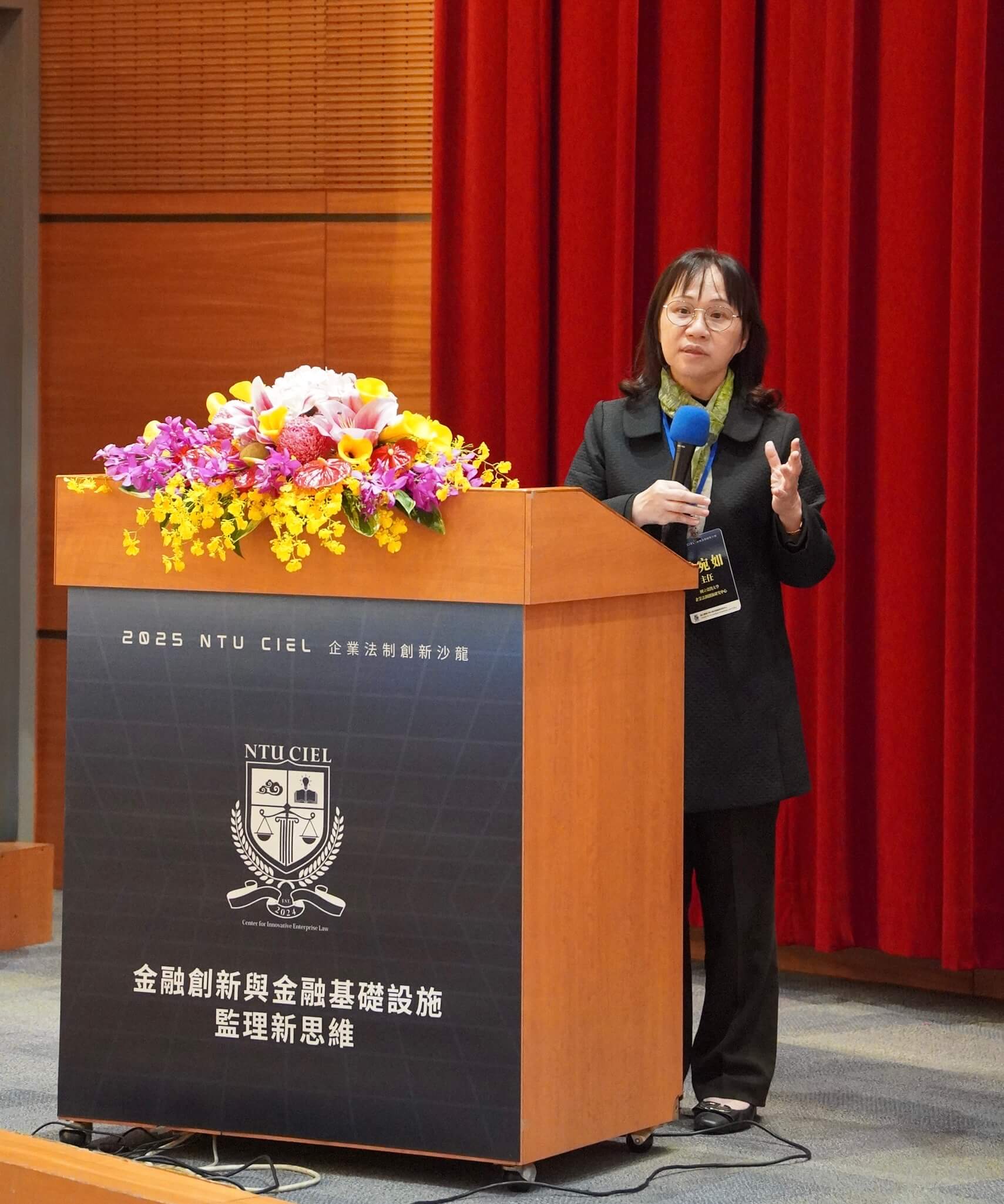
On December 15, 2025, CIEL hosted the 2025 Enterprise Law Innovation Salon, bringing together representatives from government, industry, and academia to engage in dialogue on key topics including real-world assets (RWA), cross-border payments, stablecoins, and artificial intelligence. The salon opened with welcoming remarks by Professor Wang-Ruu Tseng, Vice President of National Taiwan University and Director of CIEL. Professor Tseng emphasized that a central purpose of the salon was to shape the Center’s research agenda for the coming year through cross-sector exchange. She further expressed the expectation that financial regulatory authorities, in the course of policy formation, could draw on international practices by establishing advisory committees, issuing policy white papers, and conducting public consultations. Such mechanisms, she noted, would enable deeper regulatory research and facilitate open dialogue with industry, thereby enhancing the professionalism, transparency, and market responsiveness of regulatory frameworks.


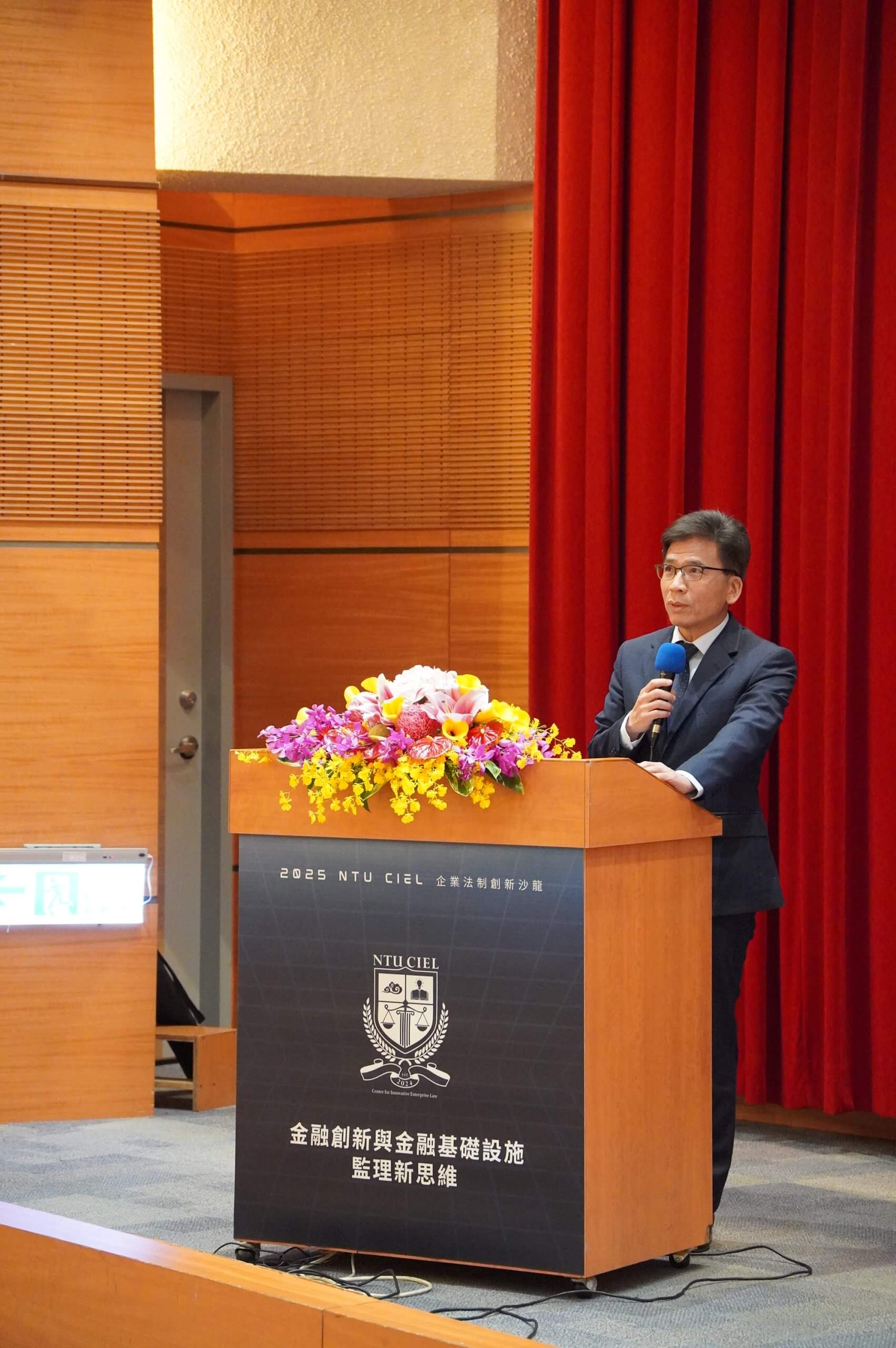
The opening session continued with remarks by Chairperson Jin-Lung Peng of the Financial Supervisory Commission. Chairperson Peng affirmed the salon’s focus on the regulation of financial market infrastructure and shared the regulator’s overarching supervisory approach to real-world assets, emerging payment instruments, and artificial intelligence. He underscored the guiding principle of “neither rushing ahead nor falling behind,” under which pilot programs and institutional discussions should be advanced in a measured and orderly manner. Using a basketball analogy, Chairperson Peng illustrated the complex relationship between industry development and rule-making, observing that many fintech innovations require the prior establishment of legal frameworks and foundational institutions in order to develop smoothly. His remarks highlighted the critical importance of legal and institutional innovation. Chairperson Peng concluded by reaffirming the significance of CIEL’s establishment and recognizing the Center’s role and contributions in advancing research on financial regulation and innovation.


Following the remarks by the two distinguished guests, Session I of the salon formally commenced. The first session, titled “Infrastructure Development and Regulatory Challenges of Real-World Assets,” was moderated by Deputy Director Yang. The panel featured Zhong-Hao Huang, Deputy Director General of the Securities and Futures Bureau (SFB) ; Hui-Hua Pai, Director of Legal Affairs and Compliance at the Taiwan Depository and Clearing Corporation (TDCC); and Hung-Chih Chen, Project Manager at the Bank of Taiwan. The panel explored the development of RWA infrastructure and the associated practical challenges from regulatory, financial market infrastructure, and banking perspectives.


During the session, Deputy Director General Huang outlined the SFB’s regulatory planning for security-token RWA, addressing potential supervisory issues across various stages, including the legal characterization of property rights, issuance and reissuance, over-the-counter trading, custody, and settlement. He also provided a comparative assessment of different blockchain architectures and their respective advantages and limitations. Director Pai drew on the TDCC’s experimental work with security-token RWA to highlight potential civil law property issues, such as the applicability of enforcement, liquidation, and inheritance regimes to tokenized securities. She further explained the role that the TDCC could play in bridging on-chain and off-chain systems, enabling investors to access securities recorded under different ledger structures. Project Manager Chen shared insights from the Bank of Taiwan’s ongoing gold RWA project, illustrating the practical impact of RWA on clearing, settlement, and the optimization of financial market infrastructure, while also identifying emerging challenges related to competition from non-bank entities, personal data protection, anti-money laundering compliance, and asset exit mechanisms.


The discussion in Session I concluded successfully. Looking ahead, CIEL will continue to facilitate dialogue among academia, practitioners, and regulatory authorities through conferences and industry salons, providing an important foundation for future research and institutional development.
2025.07.31

News

CIEL Director Professor Wang-Ruu Tseng and Deputy Director Professor Yueh-Ping Yang Invited to Attend FSC Public Hearing

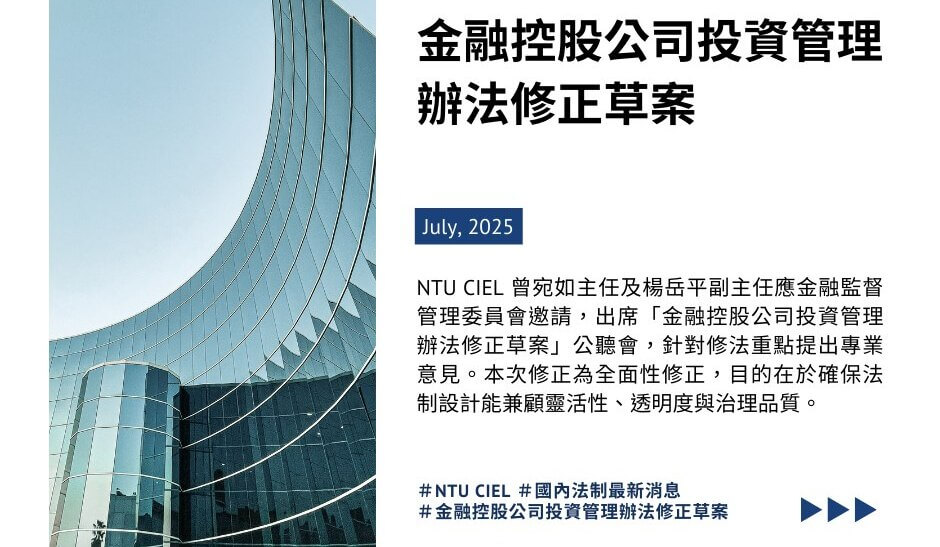
On July 31, 2025, Professor Wang-Ruu Tseng, Director of the Center for Innovative Legal and Economic Institutions (CIEL) at National Taiwan University, and Professor Yueh-Ping Yang, Deputy Director of CIEL, were invited by the Financial Supervisory Commission (FSC) to attend a public hearing on the draft amendments to the Regulations Governing the Investing Activities of a Financial Holding Company. At the hearing, they offered expert insights on key aspects of the proposed revisions, drawing on both academic research and practical experience.


The proposed amendments were initiated by the FSC in response to recent trends in financial sector consolidation and were formulated with reference to both domestic and international merger and acquisition practices. The primary objective of the revisions is to better align the regulatory framework with market realities while strengthening market order and corporate governance. During the hearing, scholars and industry representatives engaged in in-depth discussions on several critical issues, including adjustments to the shareholding thresholds for initial investments, the requirements for non-consensual mergers and the submission of feasibility plans, restrictions on consideration methods in tender offers, disclosure requirements, and the roles of boards of directors and audit committees in investment decision-making processes.


The FSC further explained that the amendments seek to reaffirm the statutory concept of controlling shareholdings under the Financial Holding Company Act while reducing regulatory uncertainty in merger and acquisition transactions. Key measures include clarifying documentation requirements for initial investments, allowing adjustment periods for the dual leverage ratio (DLR), and incorporating opinions from independent experts and audit committees to enhance the quality and procedural integrity of board decisions. In addition, the amendments regulate the timing of tender offer disclosures to prevent unnecessary market volatility prior to regulatory approval, thereby safeguarding market stability and shareholder interests.


Several recommendations raised during the public hearing by academic and industry participants were subsequently incorporated into the final amendments officially announced by the FSC on November 25, 2025. This reflects the FSC’s commitment to an inclusive consultation process and its efforts to strike an appropriate balance between regulatory oversight, market flexibility, and sound corporate governance.


CIEL has long been dedicated to the study of financial regulation and corporate governance. Going forward, the Center will continue to engage in public policy discussions and contribute academic and practical perspectives to support the development of a more transparent, resilient, and forward-looking legal framework for financial mergers and investment management.


the officially promulgated amendments

Regulations Governing the Investing Activities of a Financial Holding Company

2025.03.25

News

Deputy Director Yueh-Ping Yang Invited by Asia FinTech Alliance to Chair Keynote Session Featuring FSC Innovation Director Brenda Hu and Securities Firms Division Chief Alex Huang

Deputy Director Yueh-Ping Yang of CIEL was invited by the Asia FinTech Alliance to chair the online seminar “Regulatory Perspectives on FinTech Innovation in Taiwan” on March 25, 2025.


Serving as moderator and opening speaker, Deputy Director Yueh-Ping Yang introduced the session, which featured two distinguished speakers. Brenda Hu, Director of the Department of Financial Market Development and Innovation at the Financial Supervisory Commission (FSC), presented on Taiwan’s FinTech development strategies and progress, highlighting policy support and emerging industry opportunities. Alex Huang, Chief of the Securities Firms Division at the Securities and Futures Bureau of the FSC, shared Taiwan’s practical experience in virtual asset regulation and discussed the latest regulatory developments.


The session concluded with a comprehensive Q&A, offering participants an opportunity to engage directly with the experts and deepen dialogue.


This online seminar focused on Taiwan’s FinTech development strategies, practical approaches to virtual asset regulation, and the balance between regulation and innovation. It provided international industry leaders and policymakers with insights into Taiwan’s regulatory direction for FinTech and virtual assets, while also fostering a platform for collaboration across industry, government, and academia.


scroll_fix_img_mobile