2025.12.20

News

CIEL Deputy Director Yueh-Ping Yang Invited to the Conference “Major Constitutional Challenges in the AI Era”

On December 20, 2025, CIEL Deputy Director Professor Yueh-Ping Yang was invited to attend the conference “Major Constitutional Challenges in the AI Era,” hosted by the ROC Constitutional Law Society. Professor Yang delivered a speech entitled “AI Discrimination and Explainable AI: Focusing on AI Credits,” offering an in-depth analysis of how AI-driven decisions affect financial fairness and how law and technology can work together to respond to these challenges.


Professor Yang first introduced the provisions on AI fairness set out in the Financial Supervisory Commission’s Guidelines for Artificial Intelligence (AI) Applications in the Financial Industry. He emphasized that “fairness” does not mean uniform equality or the absence of differential treatment, but rather differential treatment with legitimate justification. The key issue lies in whether such differential treatment is grounded on reasonableness and whether it results in systematic adverse impacts on specific groups with reasonable grounds.
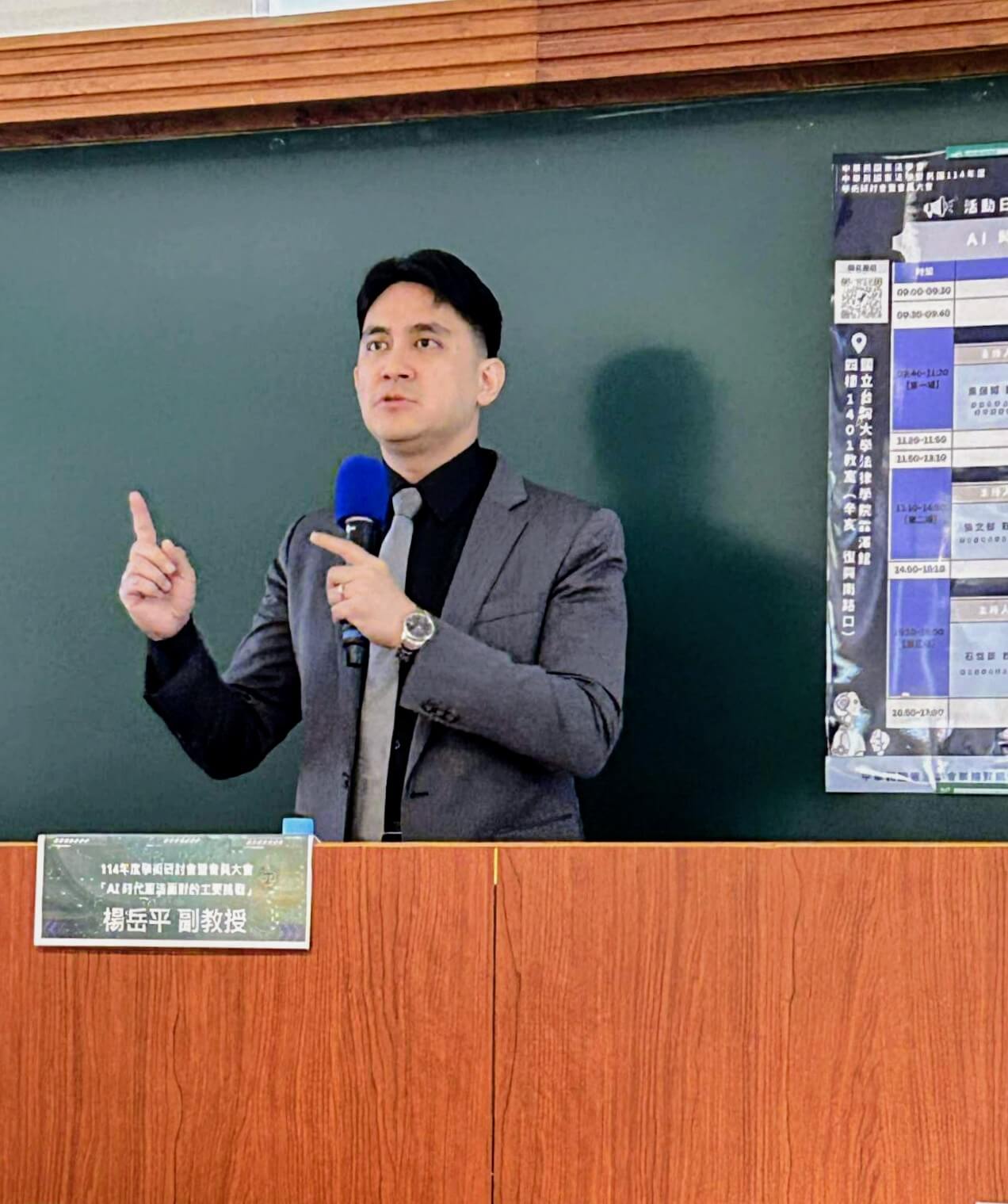


Professor Yang further noted that while AI entails risks of discrimination, a more comprehensive understanding is that AI “may be more fair than humans, yet also more discriminatory.” The fundamental risk of AI stems from its “black box” decision-making process, and Explainable Artificial Intelligence (XAI) can play a critical role in addressing this challenge. Through techniques such as SHAP, LIME, and counterfactual explanations, financial institutions can analyze the key variables used in AI-driven decisions and the influence of individual variables on outcomes, thereby assessing whether protected characteristics are being used and whether such use can be justified.


In conclusion, Professor Yang proposed the “relative black box theory,” arguing that the integration of AI with XAI does not necessarily exacerbate discrimination, but may instead facilitate more objective solutions. Nevertheless, this approach requires supporting legal frameworks, including clearly defined protected groups in relevant legislation, permitting the use of protected characteristics for testing purposes, and empowering regulators to establish acceptable thresholds for differential treatment.


CIEL will continue to closely monitor the interaction between the evolution of AI technologies and the rule of law, promote financial fairness and justice in the digital age, and contribute to the development of a more resilient and transparent AI regulatory framework in Taiwan.

2025.11.03

Events

International Academic Exchange|Professor Florence G’Sell Visits CIEL to Discuss Virtual Asset Regulation and Emerging Trends in AI Integration

On November 3, 2025, CIEL was honored to welcome Professor Florence G’Sell from Stanford Law School for an academic exchange. She engaged in an in-depth dialogue with CIEL Deputy Director Professor Yueh-Ping Yang and Professor Chao-Hung Chen on the current developments of virtual assets, artificial intelligence, and other aspects of digital laws, examined through comparative perspectives from Europe, the United States, and Asia.


🔹 Trends in Virtual Asset Regulation Across Asia
Asian jurisdictions exhibit divergent regulatory approaches to virtual assets. Japan was among the first to establish rules for stablecoins; Singapore adopts a principles-based regulatory model; Hong Kong adopts a comprehensive and rigorous framework; and South Korea continues to show a high level of regulatory attention toward virtual assets. In Taiwan, the government is actively promoting the Virtual Asset Service Act, which covers virtual asset service providers, stablecoins, and other related issues, and it is expected to be submitted to the Legislative Yuan for deliberation.


🔹 Differences in Regulatory Cultures Across Europe, the U.S., and Asia
Europe adopts a rule-based approach with comprehensive regulatory frameworks for virtual assets and artificial intelligence. However, its implementation progresses relatively slowly due to differences among its member states.The United States tends to be market-driven, with a relatively light-touch or deregulatory stance. Asia, by contrast, could be viewed as taking a middle-ground approach between Europe and the U.S., featuring pragmatic and hybrid regulatory strategies that balance flexibility and efficiency—making the region particularly significant for comparative legal studies in this area.


🔹 The Future Integration of Blockchain and AI
The integration of blockchain and AI can be seen as an next-generation model of existing blockchain-smart contract integrations, which has the potential to enhance the capabilities of both technologies. However, it may also introduce greater uncertainty, less explainability, and increased legal liability challenges.


CIEL will continue to closely follow developments in technological innovation and legal governance, foster international academic exchanges and collaboration, and contribute to forward-looking research and policy discussions.


2025.06.10

News

Deputy Director Yueh-Ping Yang Invited as Panelist at the 2025 AI FinTech Development Forum on “AI Innovation, Internationalization, and Open Banking”

Deputy Director Professor Yueh-Ping Yang of CIEL was invited by the AI FinTech Association to serve as a panelist in the session “AI Innovation, Internationalization, and Open Banking” at the 2025 AI FinTech Development Forum, held on June 10, 2025.


The forum opened with remarks from Minister of Digital Affairs Yennun Huang, Vice Chairperson of the Financial Supervisory Commission (FSC) Yen-Liang Chen, and Deputy Minister of the National Development Council Jan, Fang-Guan. The keynote address was delivered by Shih Yi-Chun, Deputy Director-General of the FSC’s Department of Financial Innovation.


As a panelist, Professor Yang shared his views on how open banking and AI-driven financial innovation are reshaping supervisory models. He emphasized that modern financial supervision is shifting away from the traditional model of “government sets the rules, industry complies” toward a more market-oriented approach of “industry designs the rules, government reviews and approves.” This transition requires financial institutions not only to demonstrate compliance capabilities but also to develop rule-making capacity, grounded in an understanding of supervisory objectives and the risk management demands of technological innovation.


Professor Yang further introduced the concept of the emerging “Washington Effect” in contrast to the previously discussed “Brussels Effect,” stressing that market-driven supervisory approaches can facilitate cross-border FinTech development and enhance global competitiveness.


For related reporting on this forum and Professor Yang’s panel discussion, please refer to: https://techorange.com/2025/06/10/2025-ai-based-fintech/

2025.05.10

Events

Event Recap: 6th YCC Workshop on Comparative Business and Financial Law

6th YCC Workshop on Comparative Business and Financial Law

Organized by the Younger Comparativists Committee of the American Society of Comparative Law


The YCC Workshop on Comparative Business and Financial Law, hosted by the Younger Comparativists Committee (YCC) of the American Society of Comparative Law (ASCL), has been held since 2014. This closed-door academic workshop is designed to provide in-depth feedback on the research of emerging scholars in comparative law, fostering scholarly growth and intellectual exchange.


Due to the global COVID-19 pandemic, the workshop was suspended after 2020. In 2025, with the appointment of Associate Professor Yueh-Ping Yang, Deputy Director of the Center for Enterprise Law at NTU, as Co-Chair of the YCC, the workshop was successfully revived and held at the College of Law, National Taiwan University—marking the first time this workshop has taken place outside of the United States. The Center played a key role in organizing the event, with both Deputy Directors, Associate Professor Yueh-Ping Yang and Associate Professor Chao-Hung Chen, actively participating throughout the workshop as hosts and discussants.


This year’s workshop featured seven selected papers by scholars from around the world:

  • Davide Luigi Totaro, Lecturer, Hitotsubashi University, Japan

  • Yung-Cheng Lin, Ph.D. candidate, University of Pennsylvania, USA

  • Samreen Ahmed, Ph.D., and Mohammad Nasir, Assistant Professor, Aligarh Muslim University, India

  • Takuma Kumashiro, Associate Professor, Kobe University, Japan

  • Akshaya Kamalnath, Associate Professor, Australian National University

  • Kwanghyuk (David) Yoo, Assistant Professor, Kean University, USA

  • Vanessa Villanueva Collao, Adjunct Professor, Bocconi University, Italy

Topics explored included:

comparative studies on AI insurance regulation (Japan–Italy), Taiwan–U.S. insurance product supervision, corporate privacy (U.S.–India), ESG enforcement in Japan, governance of emerging tech companies (U.S., EU, China, India), antitrust and consumer protection standards (U.S.–EU), and comparative legal perspectives on decentralized autonomous organizations (DAOs).


Distinguished discussants included:

  • Associate Professor Tao Xie, Oklahoma City University, USA

  • Associate Professor Liwen Lin, University of British Columbia, Canada

  • Visiting Professor Christopher Gulinello, National Taiwan University

  • Associate Professor Toshiaki Yamanaka, University of Tsukuba, Japan

  • Senior Lecturer Zehra G Kavame Eroglu, Deakin University, Australia

  • Associate Professors Yueh-Ping Yang and Chao-Hung Chen, National Taiwan University


Each presentation was allocated 45 minutes, including a 10-minute commentary by the designated discussant, a 5-minute response by the author, and an open Q&A session. These sessions fostered rich exchanges and provided young scholars with substantial feedback to refine and strengthen their research.


This workshop highlighted the diverse and interdisciplinary developments in the field of business and financial law, emphasizing the growing demand for innovative legal scholarship. As corporate legal frameworks continue to face challenges from technological shifts and globalization, comparative understanding of legal systems is essential for informed reform and cross-jurisdictional dialogue.


Looking ahead, the Center for Enterprise Law at NTU remains committed to promoting the internationalization of corporate law scholarship. We will continue to collaborate with the American Society of Comparative Law and its Younger Comparativists Committee, advancing comparative legal research and global academic exchange—offering fresh perspectives to shape the future of corporate law worldwide.


scroll_fix_img_mobile